Up and Down Again Like an Elevator
How to Survive an Elevator Free Autumn
If you lot've ever watched a disaster movie, listened to that one-time Aerosmith single or nervously glanced at a maximum load placard, you've probably pondered what you would do if you were ever trapped in a falling elevator.
Statistically, elevators are quite rubber, as long as their safety features function properly and passengers remain fully inside the motorcar. Most elevator-related injuries and fatalities happen to construction or maintenance workers, followed by people who autumn downwards shafts or are crushed after being defenseless in elevator doors or betwixt floors.
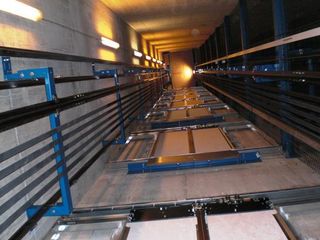
Modern elevators incorporate safe features to assist prevent fatal falls. Traction elevators, which move cars up and down using steel cables, pulleys and counterweights, have a speed-sensing governor. If the car zips down as well quickly, the governor activates brakes on the elevator'south travel rails. Traction elevators likewise locate switches along the elevator shaft, which discover cars equally they pass and initiate slowdowns and stops at the appropriate points in their travel, whether during a normal stop or because the machine is moving as well fast. Each of the 4 to viii steel cables in a traction lift is strong enough by itself to hold the car.
Hydraulic elevators, which lift and lower elevator cars using a piston jack similar to the one auto mechanics utilise to lift automobiles, generally lack the safety features of traction elevators (unless the builders install special aftermarket safety brakes). Although they are unlikely to fail, if they practice, they are more likely to fail catastrophically than traction elevators. On the plus side, it's impractical to build a hydraulic lift college than six stories, so you're just going to fall sixty to 90 feet. Then once more, that means you'll hit the basement doing a brisk 48 to 53 mph. Ouch.
What to practice
And then, yous're in a falling elevator. Life has given you lot proverbial lemons, and yous have seconds to make some lemonade or end up as lurid. What to do?
Some people advocate jumping upward a divide-2d prior to impact to reduce your impact speed. Assuming you retain the presence of listen and Olympic reactions to pull this off, however, the best speed reduction you lot could hope for would be 2 or 3 mph. More than probable, you'd hit your head on the ceiling and land badly, exacerbating your injuries.
Another suggestion holds that you lot should stand with your knees bent to blot the bear on, like a skydiver. Theoretically, your legs would flex as y'all and the elevator touched downwardly, spreading your trunk'south deceleration over a longer menstruation (bear on strength is proportional to speed and mass, and inversely proportional to time and stopping distance the longer the time spent stopping, the less the force). The effectiveness of this arroyo at high speeds, however, remains unclear, and research shows that y'all would likely be subjecting your knees and legs to greater injury risk at low speeds. This arroyo also keeps your body parallel to the lines of force, which increases the chance of os breakage as you crumple to the floor under loftier load.[How to Survive a fall From the Gilt Gate Bridge ]
With these factors in mind, the consensus view holds that your best bet is to lie flat on your back on the floor and embrace your face up and head to guard against debris. Hitting the ground floor in this position spreads the force of impact across your body; it also orients your spine and long bones perpendicular to the touch management, which will better protect them from crushing impairment. Your thinner basic, like ribs, might nevertheless snap like twigs, but you're picking your toxicant here.
Unfortunately, several problems plague even this approach.
1. Making gravy without the lumps: With your body positioned flat on the floor, your soft tissues including your encephalon and organs blot the full bear upon. Because that even low-speed fender-benders tin cause severe damage, information technology's easy to imagine the consequences of a sudden stop at 50-plus mph would exist dire indeed.
2. The tiger trap: At that place's always the possibility that no matter how well yous cushion for impact, something else volition practise you in. For example, the elevator automobile might exist destroyed on impact, transforming the flooring into a zone of impaling, lacerating and burdensome debris. Betty Lou Oliver, who holds the Guinness World Record for Longest Fall Survived in an Elevator, lived through falling 75 stories (more than 1,000 feet) in an Empire State Building elevator in 1945. Had she been lying on the floor, she probably would take been killed. (In her case, the disconnected elevator cable coiled at the bottom of the shaft softened her landing.) Some elevator shafts feature cushioned buffers designed to soften the landing of an elevator that travels past its lesser floor, but these are not designed to catch gratuitous falling cars.
3. Because you're free free falling: In a falling lift, you are in free fall relative to the car; in other words, you feel weightless and experience no force pulling you toward the floor. In order to lie down flat, you would have to find some mode to pull yourself down and and so concur yourself there without bouncing off the floor.
Even taking all these factors into business relationship, lying flat on your dorsum, if you can manage it, is still probably your best bet for surviving a falling elevator. Realistically, you're just trying to survive, and the supine approach gives the best odds. It might likewise be the statistically best option for reducing injuries over a shorter drib.
Of course, it's extremely unlikely you'll ever need to find out if this approach works, but in case you do, at to the lowest degree it's easy to call up.
- Infographic: The World's Tallest Buildings
- How to Survive a fall From the Golden Gate Bridge
- Lightning Strike Survivor Video: Existent or Fake?
vidriobarigoinathe.blogspot.com
Source: https://www.livescience.com/33445-how-survive-falling-elevator.html
0 Response to "Up and Down Again Like an Elevator"
Post a Comment